
Mitsubishi Heat Pump Owner's Guide
Quick Summary
- Set a consistent temp & avoid large thermostat swings
- Heat pumps are designed to operate with long, consistent runs times
- Avoid turning off mini-splits entirely
- Air temp at the register will be slightly cooler than a furnace
- Keep the outdoor unit clear of debris (especially snow)
- Don’t forget mini-splits contain filters that require cleaning!

1. Set a Consistent Temperature (especially during extreme weather)
Mitsubishi heat pumps are designed to maintain a consistent temperature rather than repeatedly heating and cooling the home. One of the most common mistakes is frequently adjusting the thermostat during especially hot or cool weather. Heat pumps, unlike gas furnaces are unable to produce large quantities of heat. This is by design, rather than an inherent flaw. Think of them like a diesel engine, they perform best when operating for long periods at low to moderates stress levels.
Because of this design, a heat pump system cannot provide a dramatic change to indoor temperatures in a short period of time. For example, if you turn your thermostat down to 63F at night during the winter, it may take a couple hours to return to 70 in the morning. This is heavily dependent on outdoor temperature. It it’s <30F, the impact is more pronounced.
Ok, but I like to sleep in a cool room. What should I do?
If you’re home has a whole house heat pump (i.e. the heat pump air handler replaced your gas furnace), achieving a cool room is best accomplished by closing the register in the evening. This will allow the rest of the home to maintain a steady temperature during the night. In the morning, simply open the register in the bedroom.
If your bedroom has a dedicated mini-split, you’re fine to turn the temperature down at night. While it may take time to achieve the desired daytime temperature, it likely won’t impact your comfort, as you’ll likely occupy other areas of the home.
Best practices for summer cooling
During the summer, many homeowners are tempted to to save energy by waiting until the last minute to turn on their mini-split in their bedroom. This can lead to comfort issues if the unit fails to deliver the desired sleep temperature in time.
Below is an example schedule for summer cooling (assuming an 11pm bedtime and desired temp of 70F):
- 75F daytime temp (i.e. 8am to 9:00pm)
- 9:00pm, set temp to 70F
This arrangement will allow 2 hours for the mini-split to cool the room to your desired temp. If you turn the unit off completely and the room reaches 78-80F, it could take several hours to drop the room to 70F.
2. Expect Longer Run Times
Your Mitsubishi system may run for many hours at a time. This is normal and actually a key benefit of heat pumps. Unlike traditional systems that cycle on and off at full capacity, Mitsubishi equipment uses inverter technology that automatically adjusts output to match the home’s needs. A system running continuously at low speed is often operating exactly as designed. In fact, short run times, referred to as ‘short cycling’ are much harder on the equipment.
3. The Air From Your Heat Pump Air Handler Will Be Less Hot Than a Furnace
The heated air coming from a heat pump is often significantly cooler than a comparable gas furnace. A furnace typically produces an temp of ~120F at the register, while a heat pump will often produce air 20F cooler. This can be quite a surprise to homeowners who expect air from the vents to feel similar to a gas furnace.
This is normal and does not indicate a problem. Heat pumps work by stripping off a relatively small amount of heat from the outside air and cycling this through the home. While it may take some adjustment, it actually produces a much more consistent air temperature in the home. The goal is to continuously replace heat being lost from the home rather than periodically blasting very hot air.
This can occasionally cause comfort issues if you’re sitting directly in the pathway of a nearby register. In these cases, we can help install a register with custom louvers to direct the air in an alternate direction.
4. Use Heat or Cool Mode Instead of Auto
For most homes, we recommend selecting either Heat Mode during the heating season or Cool Mode during the cooling season. The auto mode can create issues, especially with multi-zone systems, particularly during spring and fall weather.
5. Avoid Turning Indoor Units Off Entirely
If your home has multiple indoor units (heads/mini-splits), avoid turning units completely off unless necessary. Mitsubishi systems are designed assuming airflow through all connected indoor units. Frequently turning units on and off can reduce efficiency, affect comfort in other rooms and increase system workload. If a room is not being used, a small temperature adjustment is usually preferable to shutting the unit off completely.
6. Defrost Cycles Are Normal
During cold weather, frost naturally forms on the outdoor unit. To remove frost, the system periodically enters a defrost cycle. This can appear as a system malfunction to customers. It can produce strange sounds and effects. These are normal operating conditions and typically last only a few minutes.
During defrost:
- Steam may rise from the outdoor unit.
- The outdoor fan may stop.
- Indoor airflow may temporarily stop.
- You may hear refrigerant flowing through the system.
7. Keep the Outdoor Unit Clear
The outdoor unit needs unrestricted airflow to operate efficiently. Please keep leaves, snow, ice, vegetation, storage items and other away from the unit. The is especially important if your unit sits below a tree that drops needles or leaves. Also, during winter storms, check that snow has not blocked the air intake or discharge areas.
8. Clean Filters Regularly
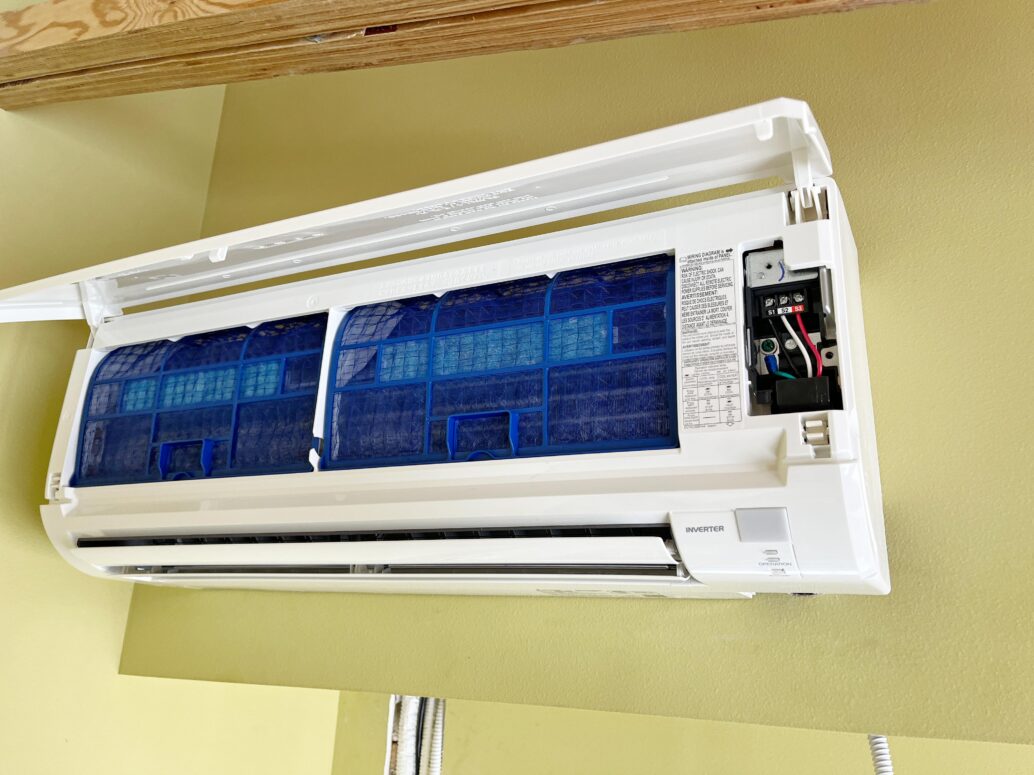
Many homeowners don’t realize their mini-split units contain filters. Unlike a traditional filter on a furnace, these are washable filters and do not require replacement. They can be cleaned by rinsing with water or gentle vacuuming. If you have pets or high dust levels, check these more often.
Cleaning schedule
- We recommend starting with a 6 month cleaning cycle (set a calendar event on your phone)
- If the filter is noticeably dirty, increase the frequency to 3-4 months.
To clean:
- Turn the unit off.
- Remove the front cover.
- Remove the filters.
- Vacuum or rinse with water.
- Allow filters to dry completely before reinstalling.
9. Understand Fan Operation
Mitsubishi indoor units do not always behave like traditional furnaces.
You may notice:
- The fan speed changing automatically.
- The fan stopping temporarily.
- Airflow slowing during heating operation.
- The unit becoming nearly silent.
These are normal functions designed to maximize comfort and efficiency.
12. Multi-zone Systems
- Avoid turning off mini-splits entirely. Simply adjust the temperature instead.
- A system cannot provide heating and cooling to different indoor units at the same time.
- Small variations beyond the thermostat are normal
Multi-zone systems share capacity between indoor units. As a result, the performance of one indoor unit can affect the others. For example, if you shut off one mini-split entirely, the other units may continue to heat or cool beyond the desired temperature. This is the systems response to the sudden excess in capacity created by the reduced number of indoor units. The variable speed compressor can eventually adapt to the change, but in the short term, it must find an outlet for the excess energy.
13. When to Call for Service
Contact Elevation Heating & Cooling if you experience:
- The system is not heating or cooling.
- Error codes on the controller.
- Water leaking from an indoor unit.
- Persistent unusual noises.
- Repeated breaker trips.
- Ice buildup that does not clear after several hours.
- Significant changes in comfort or airflow.