
HRV vs. ERV for Seattle Area Homes
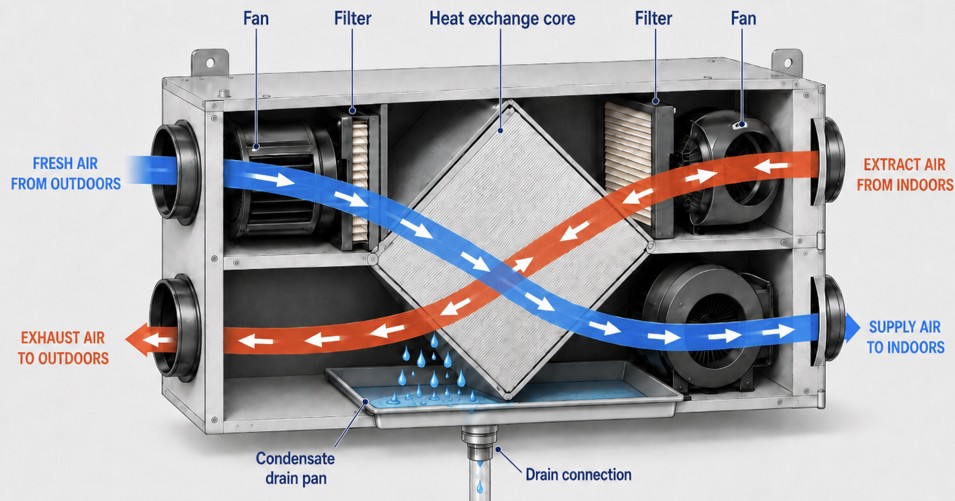
One of the ironies of increasing the energy efficiency of our homes is the unfortunate side effect on indoor air quality. Unless you actively improve the ventilation, each increase in the air tightness of a home leads to a decrease in indoor air quality (unless the outside air is unusually polluted). This leads to humurous conclusions in the code, which first require builders to go to great lengths to air seal homes, and subsequently, reverse this by installing mechanical ventilation. The energy efficiency gained by sealing the house are reversed by the ventilation. One could argue we should forego the air sealing and ventilation all together and just return to the leaky houses of past decades. But a better way does exist. Enter the world of HRVs and ERVs.
These devices seem to accomplish the impossible. They bring in fresh air, but minimize the energy loss of piping in cold outside air. They do this by running the stale (but warm) air through a heat exchanger. The fresh (but cold) outside air is passed through the device and grabs the heat from the outgoing air. The system is not 100% efficient, but can readily recover 65-85% of the energy. During the process, the air never actually touches each other, so the incoming fresh air remains free of indoor pollutants.
In most parts of the country, an ERV is the right fit. They excel in climates with warm, humid summers or regions with cool, dry winters. The Pacific Northwest has neither. Our summers are relatively dry (low humidity) but our winter months are quite damp. This is actually good news – reducing our humidity and improving our air quality is easy. We simply need to bring in fresh outside air and heat it up. No dehumidification is necessary. Raising the temperature of the air from ~40F to 70F dramatically lowers the relative humidity.
The difference between an HRV and ERV
An HRV’s core transfers heat between the two air streams and nothing else. The air passes through an impermeable core, transferring heat, but not moisture. An ERV’s core is built from a moisture-permeable material, so water vapor crosses too — typically 55–65% of it. The moisture you just exhausted comes back in with the fresh air.

In short, an HRV exhausts humidity, ERV retains it. In a Puget Sound winter, a heat recovery ventilator carries roughly three gallons of water out of a house every day. For scale: a household of four generates something like two to three gallons of water a day through showering, cooking, laundry, houseplants, and simply breathing. At 25 lb/day the HRV keeps pace with that. At 10 lb/day the ERV runs a standing deficit, and the surplus has to go somewhere — which in practice means the coldest surfaces in the house.
Why this works in the Pacific Northwest
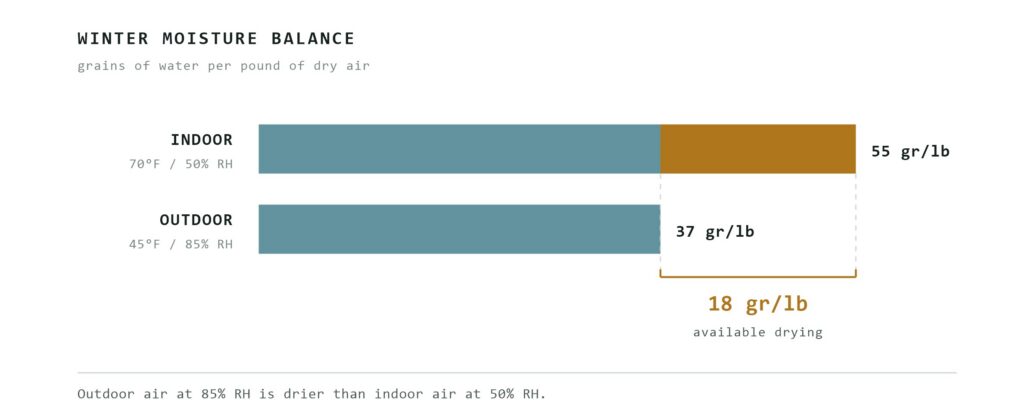
Seattle winters feel damp because outdoor relative humidity is high — 85% on an ordinary January afternoon. But cold air physically cannot hold much water, so the actual amount of humidity in the air (absolute humidity) is very low. This is even the case when it’s foggy and raining. The air feels damp, but only because the cold air is unable to hold much water. Therefore, relative humidity only tells you how full the air is relative to its capacity. What matters for drying a house is the absolute moisture content: grains of water per pound of dry air. This is the counterintuitive part. That 85% air outside is drier than the 50% air in your living room.
Where ERVs excel
The counterintuitive part: ERVs make more sense in severe cold, not less. A Montana January has an enormous indoor-to-outdoor moisture differential, so even after the core gives 60% back, plenty of drying remains — and there’s a genuine risk of over-drying a house to the point of chapped skin, static, and split trim. Moisture recovery is doing useful work there. Marine 4C (Puget Sound) starts with a small differential. Give most of a small number away and there is very little left to work with. The mildness of our winters, which is what makes this a pleasant place to live, is exactly what makes the ERV’s moisture retention a liability.
Key specs to consider for HRVs
- HRV, balanced supply and exhaust. Dedicated ductwork where the framing allows it — stale-air pickups in bathrooms and the laundry, fresh supply to bedrooms and living space. Fully independent ducting keeps the ventilation rate decoupled from whatever the furnace or air handler happens to be doing.
- Sizing – Continuous rate around 55–60% of the unit’s maximum. A unit cruising at part speed is quieter, gentler on the core, and leaves real headroom when the boost function is wired to the bathroom switches. Verify the rating at realistic external static, not at zero.
- Controls – Auto-balancing ECM blowers are worth paying for. They hold the commissioned airflow as filters load and hoods foul, which means the rate you documented on the load calc is still the rate the house gets in year five.
Are high efficiency models worth it in our area?
A mid-tier HRV at 68% sensible recovery versus a premium unit at 85% is a real difference — worth roughly 1.8 MMBtu a year at 90 CFM in our climate. Delivered by a heat pump, that’s on the order of $20–25 annually, maybe $45 once you count the fan-power difference. Against a premium that typically runs well over a thousand dollars, the payback is measured in decades. That math flips in a cold climate, where the same efficiency gap is worth several hundred dollars a year. Here, spend the money on sound, filtration, and balanced airflow instead — those you’ll actually notice.
Assumptions behind the numbers